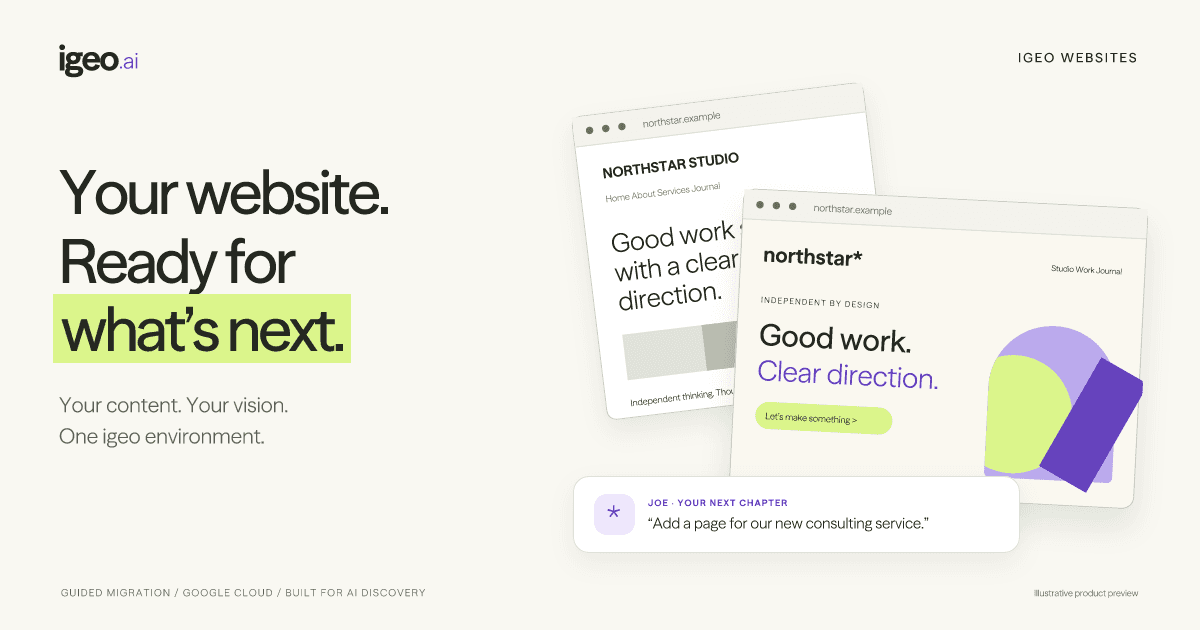
Your next website starts with the one you have.
Today, we’re introducing igeo Websites: a guided way to bring your existing content into a fresh website built for AI search, hosted on Google Cloud, and ready for ongoing improvements with Joe in WhatsApp or Slack.
Most businesses already have the ingredients for a useful website. They have service pages, articles, images, customer questions, and years of knowledge about what they do. A redesign should help that work reach people more clearly. It should also give the team a practical way to keep the site current after launch.
igeo Websites brings those needs together: your content, a new design, a fast technical foundation, and a conversation that continues as your business changes.
Start with the content you already own
A website project often begins with a blank page. For an established business, the more useful starting point is an inventory.
Which pages explain your services well? Which articles still answer real customer questions? Which images belong with the next version of your brand? What should remain familiar, and what has become difficult to navigate?
Bring your content from any CMS. We work with you to assess the existing site and plan the pages, articles, images, and site structure you want to carry forward. The source site becomes the starting material for a guided migration and redesign.
That assessment also identifies the details that need their own plan. Existing URLs, redirects, custom forms, and integrations deserve explicit decisions. A page of editorial content and a custom booking system have different requirements. We agree what is included before treating the new site as ready to launch.
The launch offering focuses on content websites: the pages and resources that explain your business and help people decide whether to work with you. Ecommerce checkout and custom application behavior sit outside that scope.
Give that content a clearer design
Keeping useful content does not mean keeping every layout decision from the old website.
The redesign is an opportunity to make the important information easier to find: what you offer, who it is for, how your approach works, and what a visitor should do next. A long service page might need a clearer hierarchy. A growing article library might need a more useful structure. Your visual identity might need room to breathe on a smaller screen.
We bring the content and the design into the same review. You can assess how the new site presents your business, check the copy and imagery, and discuss the details that matter before launch. The goal is a website your team recognizes as its own and can keep developing over time.
Build a foundation for people and AI search
Good content needs to be accessible in the page itself. Clear headings, meaningful links, accurate descriptions, and direct answers help visitors understand a business. They also give search systems useful material to read.
The igeo website foundation includes static HTML, page metadata, a sitemap, structured content, and an llms.txt briefing. These provide ways to describe the business and organize its information beyond the visual design. Google Cloud hosting supports the delivery of the published site.
Those foundations are part of the work, alongside the substance of the content. A service page still needs to explain the service. An article still needs to answer its reader’s question. Structured data should describe what is actually on the site.
AI engines decide what they crawl, index, and cite. A well-prepared website gives them accessible information; it does not guarantee inclusion in a particular answer. That is why monitoring and AI Search Console remain useful after publication: they help you observe what happens next.
AI already decides how your brand shows up.
Every prompt, citation, and recommendation is a signal. igeo.ai turns that behavior into clear answers and the next action, whether that’s a page to rewrite, a schema to add, or a story to publish.
Put performance claims next to the evidence
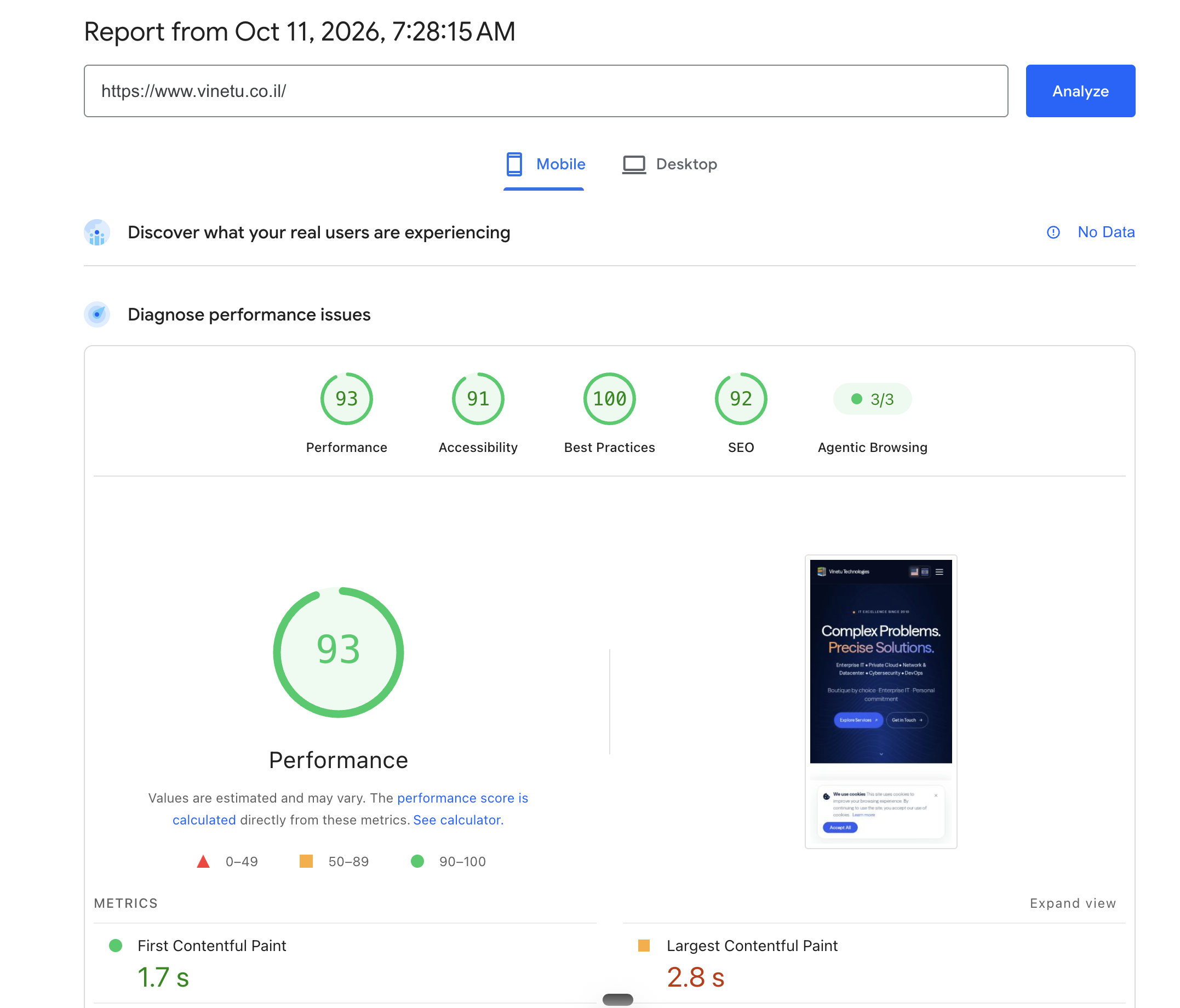
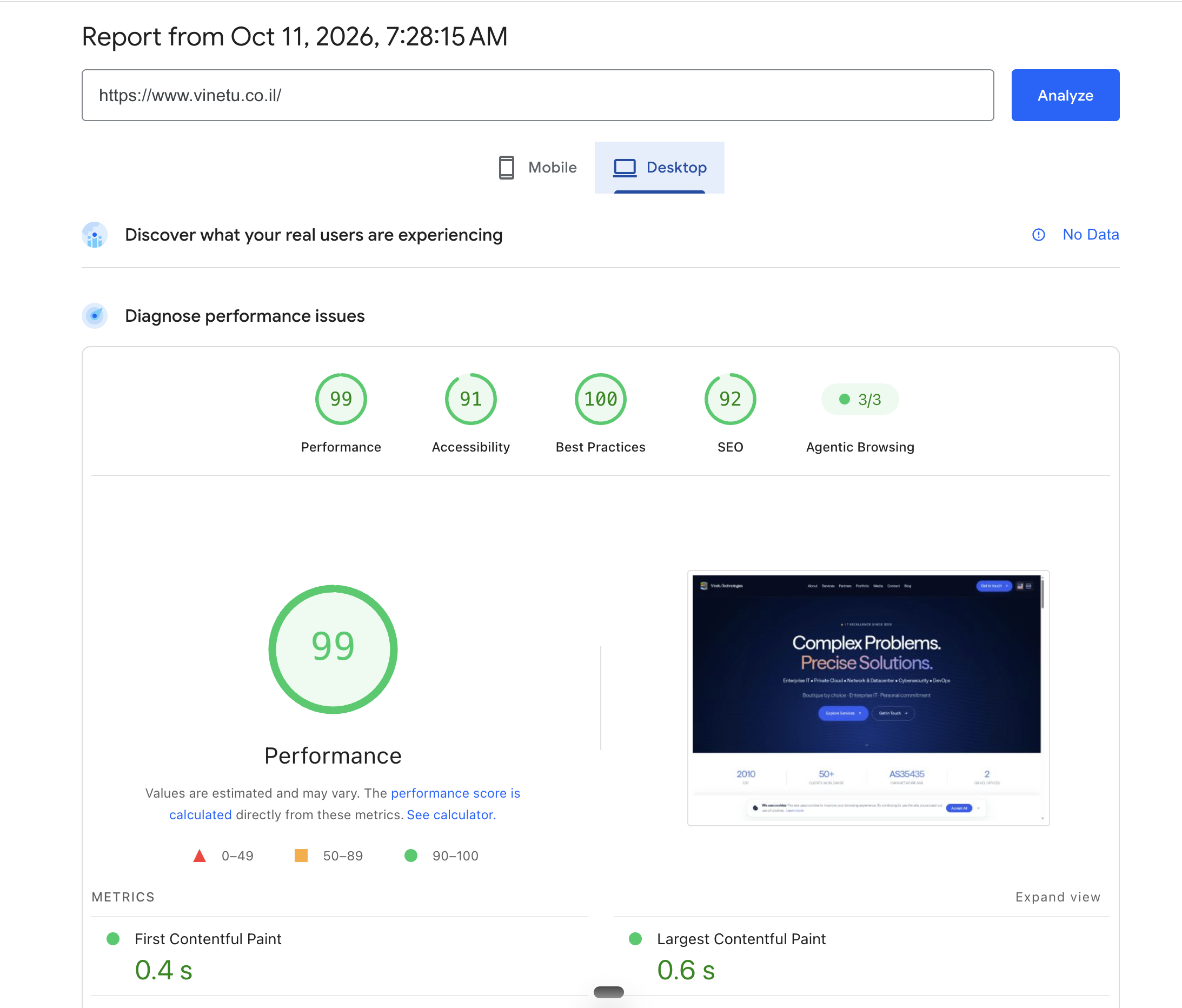
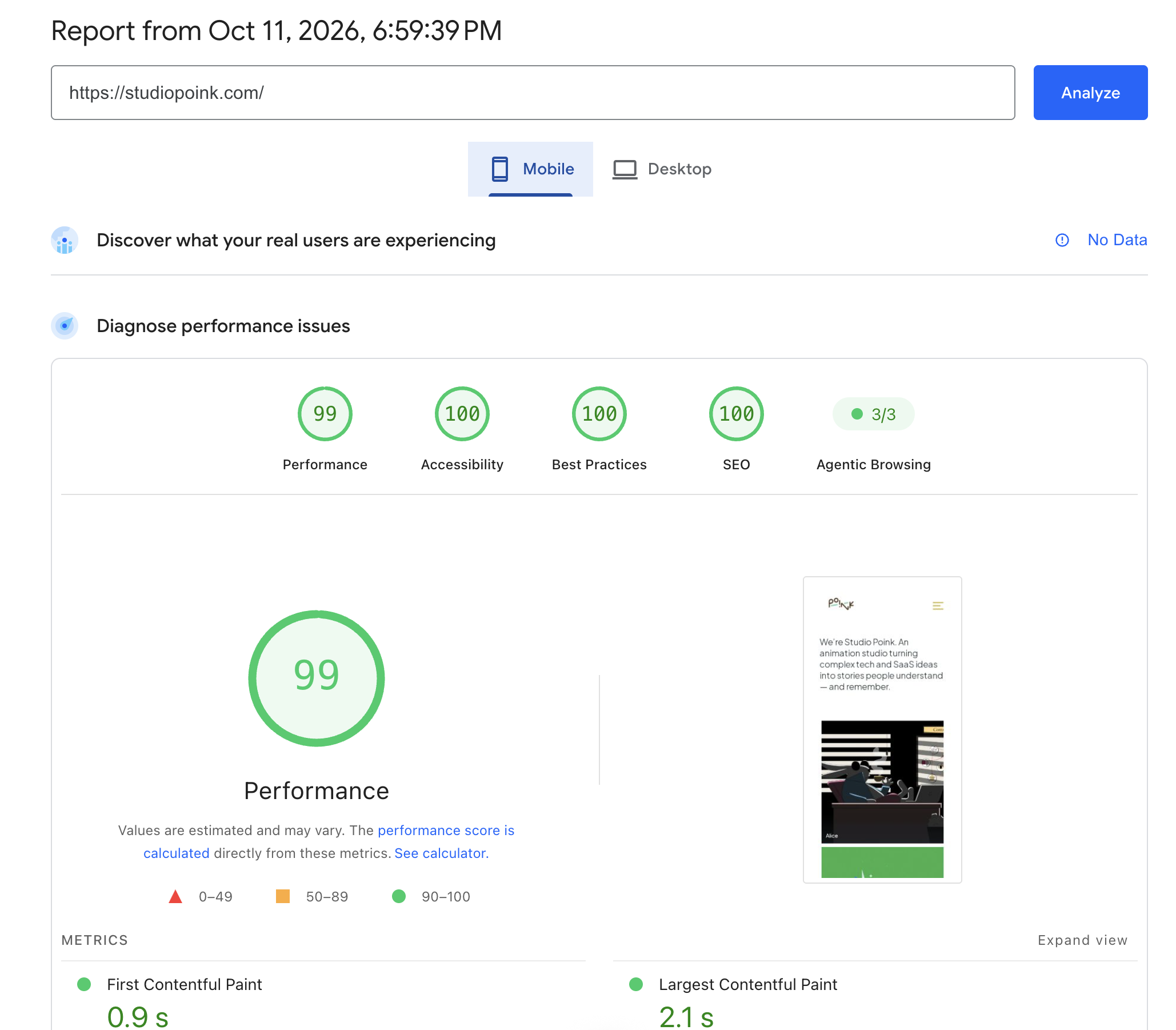
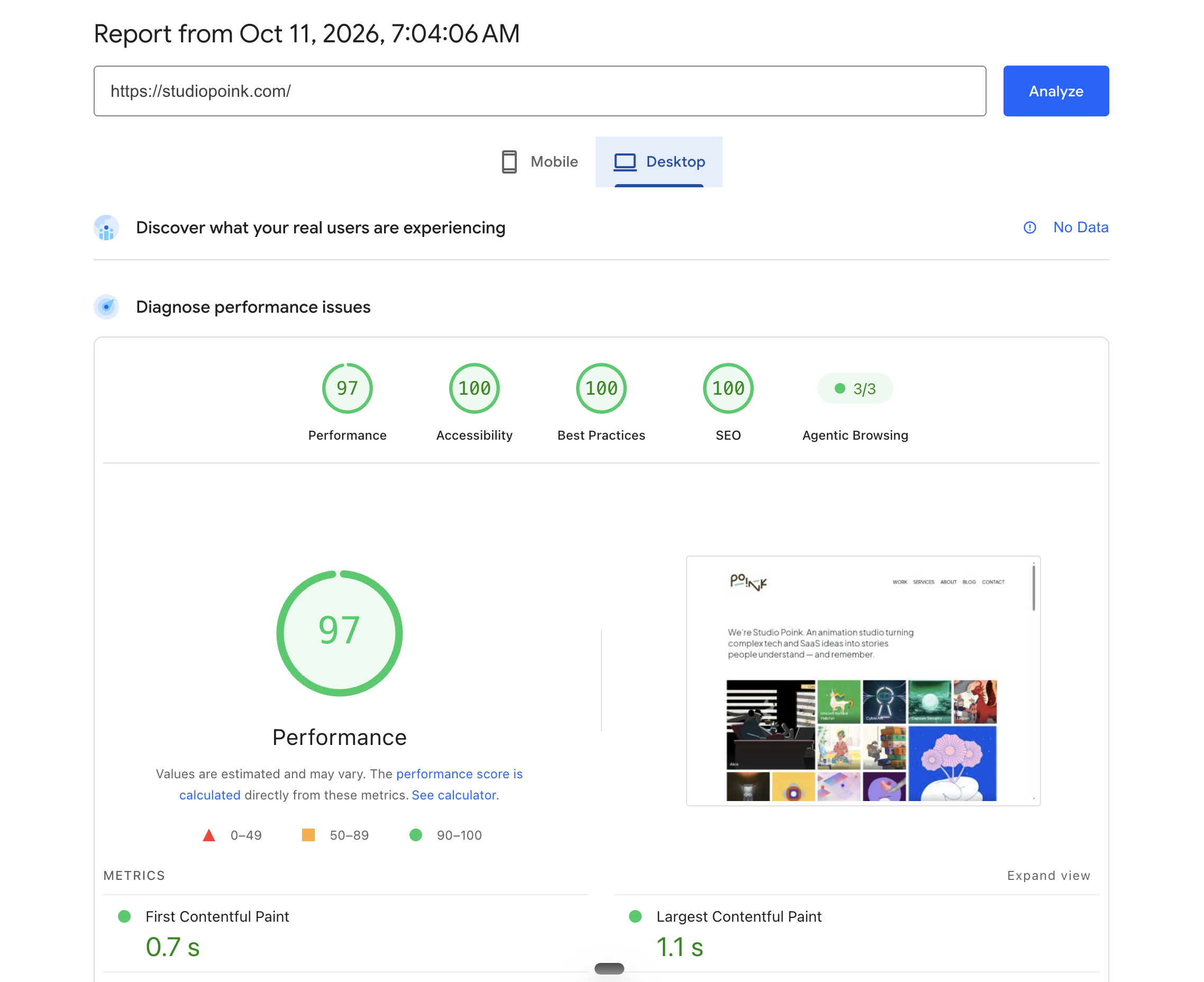
We want performance to be something you can inspect. The reports below show mobile and desktop lab measurements dated October 11, 2026, with the tested page and conditions attached to the evidence.
Vinetu
| Metric | Mobile | Desktop |
|---|---|---|
| Performance | 93 | 99 |
| Accessibility | 91 | 91 |
| Best Practices | 100 | 100 |
| SEO | 92 | 92 |
| Agentic Browsing | 3/3 | 3/3 |
Studio Poink
| Metric | Mobile | Desktop |
|---|---|---|
| Performance | 99 | 97 |
| Accessibility | 100 | 100 |
| Best Practices | 100 | 100 |
| SEO | 100 | 100 |
| Agentic Browsing | 3/3 | 3/3 |
Read these as measurements of the tested page at that time. They are not a before-and-after migration comparison or a promised score for every website. Images, content, third-party scripts, integrations, and test conditions all affect results.
For a migration, the useful conversation is specific: what does this site need, what is slowing it down, and which changes will help visitors use it? A score can help identify work. It cannot tell the whole story about accessibility, usability, or business performance.
Keep improving with Joe in WhatsApp or Slack
Launching a website is one moment in a much longer relationship with your customers. Services change. New questions appear. An explanation that worked last year may no longer reflect the way your business operates.
With Joe, ongoing website work can start in the tools your team already uses. Ask through WhatsApp or Slack:
Add a page for our new consulting service.
Or use the conversation to think through the content before asking for a change:
What questions are our service pages missing?
You can discuss a new page, request a copy update, or work through how to explain an offering more clearly. Give Joe the relevant facts and the outcome you want. The agreed scope and account setup shape how requests are handled.
This makes room for regular improvements without requiring every idea to begin as a new website project. Your team can keep the site connected to the questions it hears in sales calls, support conversations, and everyday customer work.
Plan your migration
igeo Websites is available as a guided service. Start with your current URL and what you want the next version of the site to achieve. We’ll discuss the content to bring forward, the design direction, and the technical details that need attention.
Bring the pages you value and the questions you have. Your existing website gives us a starting point; the migration plan gives the next one a clear scope.
Frequently asked questions
Can I bring content from my current CMS?
Yes. igeo Websites offers a guided migration for content websites, starting with your existing site and the pages, articles, images, and structure you want to bring forward. The team assesses the source and agrees the migration scope. URL handling, redirects, custom forms, and integrations are reviewed separately; this is not a promise that every CMS feature transfers automatically.
Can Joe help me update the website through WhatsApp or Slack?
Yes. Joe supports ongoing website requests through WhatsApp and Slack. You can ask for a new service page, request copy changes, or discuss questions your existing content should answer. The agreed scope and account setup determine how requests are handled.
Do the benchmarks guarantee the same score for my website?
No. The published mobile and desktop reports are dated lab measurements of the tested page under specific conditions. Your content, images, scripts, integrations, and test conditions affect the results. Performance scores do not guarantee AI indexing, citations, rankings, or business outcomes.
Is igeo Websites available for ecommerce stores?
The launch offering focuses on content websites. Ecommerce functionality, checkout, and custom application behavior are outside this launch scope. Discuss the needs of your site with the team before planning a migration.